


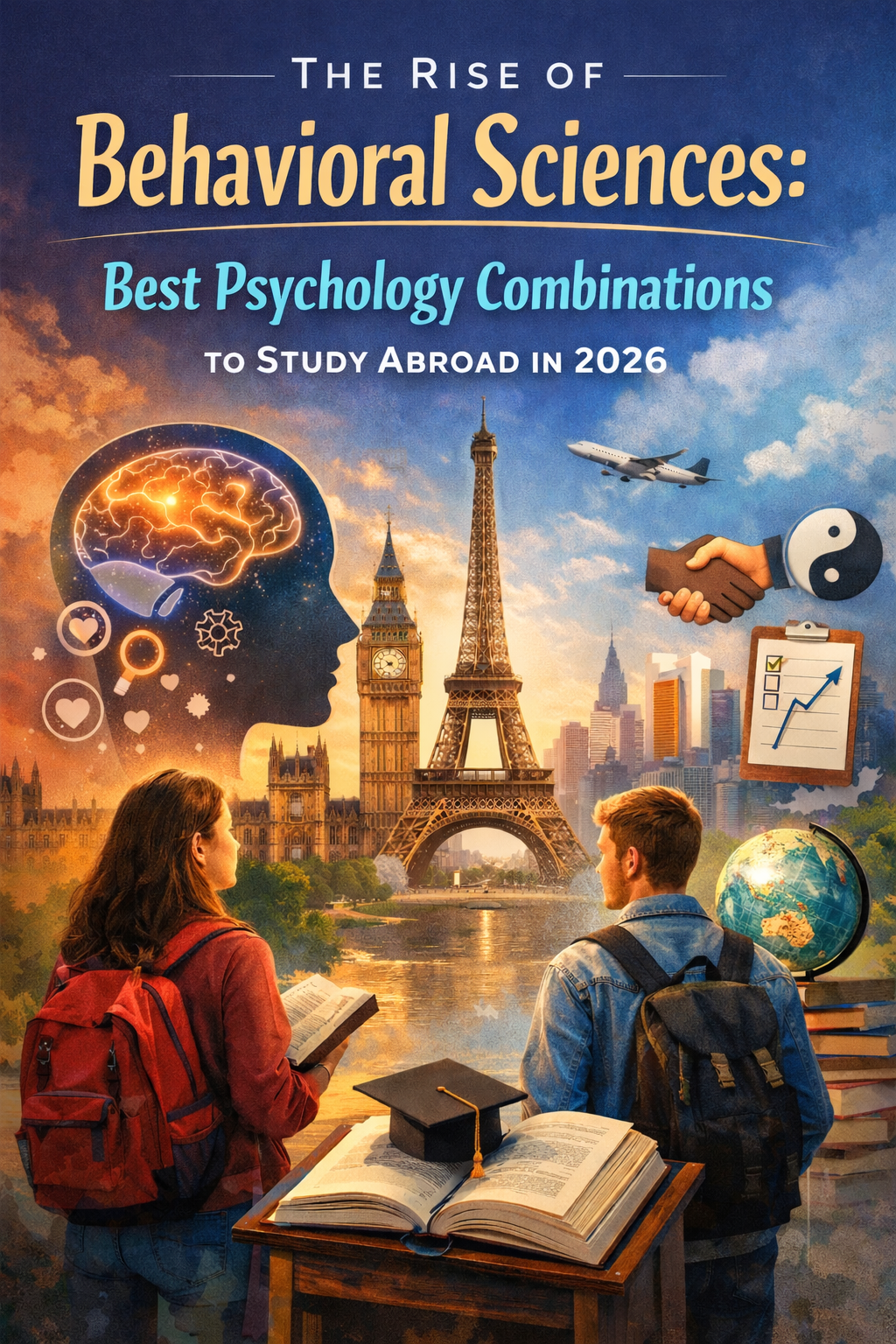
Let’s
start with a scene.
You’re
sitting in a counselling session, and a student says: “I love psychology…but I
don’t want only therapy. I want options. I want growth. I want something
future-proof.”
And
honestly?
They’re
not wrong.
Because
psychology today is no longer confined to a quiet room with a couch and a
clipboard. In 2025, psychology has stepped out into the world - into courtrooms
and corporate offices, into classrooms and sports arenas, into tech labs and
financial markets.
This
shift has a name. Behavioral Science. And it’s changing how students study and
work globally.
If
you’re dreaming of studying psychology abroad, this is the most exciting time
to do it.
Let
us walk you through where psychology is going, and the powerful
combinations that are leading the way.
When
Psychology Walks into a Crime Scene
For
the students who always ask “why”.
Some
students are fascinated by the human mind at its darkest moments. They don’t
just want to know what happened, they want to know why it happened.
This
is where psychology meets crime, law, and justice.
At
universities like the University of Leicester, students get to explore criminal
behaviour through BSc Criminology with Forensic Psychology. While others
head to Aberdeen or Strathclyde, where psychology intertwines with legal
systems and courtroom decision-making.
These
students don’t graduate with just knowing theories, they graduate understanding
human motivation, accountability, and reform.
They
go on to become forensic psychologists, criminal analysts, legal consultants,
and policy advisors shaping systems, not just observing them.
When
Psychology Sits at the Boardroom Table
Because
every business decision is a human decision. Now imagine psychology walking
into a meeting room.
A
brand wants to know why its campaign didn’t work.
A company wants leaders people actually trust.
A startup wants users to stay, click, return.
This
is where psychology meets business, marketing, and management.
At
places like the University of Sussex and Lancaster University, psychology
blends seamlessly with marketing strategies, leadership theory, and
organisational behaviour. Some courses even include professional placement
years, giving students real industry exposure before they graduate.
These
students don’t just study people, they work with people.
They
become brand strategists, HR professionals, consultants, and business analysts
turning human insight into competitive advantage.
When
Psychology Explains Money
Why
logic isn’t always logical.
Ever
wondered why people panic during stock market crashes?
Why we spend impulsively even when we know better?
That’s
psychology quietly influencing economics.
Welcome
to Behavioral Economics.
At
universities like Aberdeen and Strathclyde, students get to learn how emotions,
biases, and decision-making patterns shape financial systems. Psychology teams
up with economics and mathematics in order to decode human behaviour in
markets.
Graduates
step into these roles as financial analysts, policy advisors, data strategists,
and researchers often influencing decisions at a national or global level.
This
path is perfect for students who like numbers…but love understanding people
behind the numbers.
When
Psychology Goes Inside the Brain
From
thoughts to neurons. Some students want to go deeper right into the biology of
behaviour.
They
want to know: How does the brain create emotion? What happens neurologically
when we learn, fear, or love?
Courses
like Neuroscience with Psychology at the University of Sussex or Biology with
Psychology at Lancaster answer these questions head-on.
This
path then leads to research labs, healthcare settings, and advanced scientific
careers, ideal for students drawn to medicine, neuroscience, and cognitive
science.
When
Psychology Shapes Learning and Performance
In
classrooms and on the field, others are often drawn to human potential.
How
do children learn best? What makes athletes perform well under pressure?
At
universities like Bristol and Hertfordshire, psychology merges with education
and sports studies, helping students understand the learning styles,
motivation, and performance psychology.
Graduates
often work as educational psychologists, learning specialists, sports
psychologists, and performance coaches helping people become the best versions
of themselves.
When
Psychology Designs the Future
Human-first
technology. Technology isn’t just about systems, it’s about users.
That’s
why psychology is now central to innovation, computing, and AI.
At
Bristol and University College Cork, students combine psychology with both
innovation and computing, learning how humans interact with technology and how
to design better digital experiences. These graduates’ step into cutting-edge
roles like UX researchers, product designers, and human-centered AI
specialists.
When
Psychology Tells Our Story
Culture,
history, and expression. Some students fall in love with psychology because it
explains society itself.
At
universities like Hertfordshire and Strathclyde, psychology pairs with
sociology, history, English, and creative writing exploring how culture,
language, and history shape behaviour.
These
students often become writers, policy analysts, social researchers, and
communications specialists - voices that influence conversations and change
narratives.
When
Psychology Supports People Directly
Workplaces,
wellbeing, and care. And of course, psychology never leaves its roots.
Through
combinations with counselling and human resource management like at Deakin
University, Aberdeen, and Strathclyde, students build strong people-focused
careers in HR, counselling, wellbeing consulting, and organisational
psychology.
The
Takeaway
Psychology
in 2025 isn’t a single path. It’s in boardrooms, courtrooms, labs, classrooms,
startups, sports fields, tech hubs and policy rooms.
So,
the real question isn’t: “Should I study psychology?”
It’s:
And
with the right study abroad guidance, that answer becomes much clearer.
Ready
to start your psychology journey abroad? Let’s turn curiosity into a global
career.
Personalized, transparent, and reliable counselling to help students choose the right course, country, and university—for FREE.

Mancomp Overseas Education Private Limited, Door No. 303, 12/1, Second Floor, Sona Complex, 52nd Street, 7th Avenue, Ashok Nagar, Chennai – 600083



.png)